A View to the Future: Leadership Trends in 2026 and Beyond
As organizations move toward 2026, one message is coming through clearly in our conversations with clients: Leadership is getting harder, not just due to uncertainty but because of the accumulation of pressure, complexity, and expectation.
To close out 2025, RHR surveyed our leadership consultants about the leadership landscape across industries and geographies. We learned they are hearing several key challenges from chief executive officers, chief human resources officers, boards, and executive teams. We viewed their responses through three lenses: 1) what stood out in 2025, 2) what leadership capabilities are now emerging as critical, and 3) what clients are prioritizing as they look ahead. The result is a remarkably clear picture of what leadership in 2026 will look like.
1. Leadership reality: relentless complexity and pressure
Looking back on 2025, leaders were not simply navigating disruption—they were navigating overlapping disruptions at the same time.
RHR leadership consultants consistently described leaders grappling with:
- Persistent macroeconomic uncertainty and geopolitical volatility.
- Accelerating technological change, particularly around AI.
- Increased scrutiny from boards, investors, employees, and regulators.
- Intensifying workload and emotional strain at the top.
Many leaders expressed a sense that the pace and volume of demands had crossed a threshold. The challenge was no longer just “making good decisions” but also sustaining clarity, energy, and judgment over time.
At the same time, there is a renewed seriousness around leadership fundamentals: succession planning, enterprise mindset, and leadership bench strength. Under pressure, organizations were reminded—sometimes painfully—that leadership capacity is a strategic asset, not a nice-to-have.
Key insight:
2025 revealed resilience is no longer an individual luxury; it is an organizational requirement. Leaders who lacked support or alignment struggled to keep up.
2. The accelerated pace of technology requires judgment, integration, and human ability
When consultants described what they are hearing in the marketplace now, a striking shift emerged. The conversation has moved beyond “skills” to judgment, maturity, and integration.
Several themes stood out:
The return of experienced leadership
Clients are expressing concern about whether they have enough leaders who can:
- Operate effectively in ambiguity.
- Balance short-term performance with long-term enterprise health.
- Make high-stakes decisions without complete data.
Experience—real pattern recognition built over time—is once again highly valued.
Leadership in an AI-enabled workplace
Although AI is creating opportunity, it is also increasing pressure on leaders to:
- Make sense of rapid technological change.
- Redesign roles, decision rights, and workflows.
- Lead people through fear, skepticism, and skills disruption.
Clients are not just asking, “How do we use AI?” but “How do we lead humans through AI-driven change?”
The human side of leadership is becoming harder to preserve
Expectations around organizational empathy and inclusion remain high, and leaders are being asked to continue to excel at these while managing unprecedented operational and strategic complexities. The balancing act is difficult as the world is seeking leaders who can deliver business results and demonstrate a level of humanity, empathy, and care.
Key insight:
The leaders who will succeed are not the most technical or charismatic but rather those who can integrate strategy, technology, and human dynamics without losing their center.
3. What leaders are prioritizing for 2026
As leaders look toward 2026, their priorities reflect both urgency and realism. RHR consultants report a strong focus on:
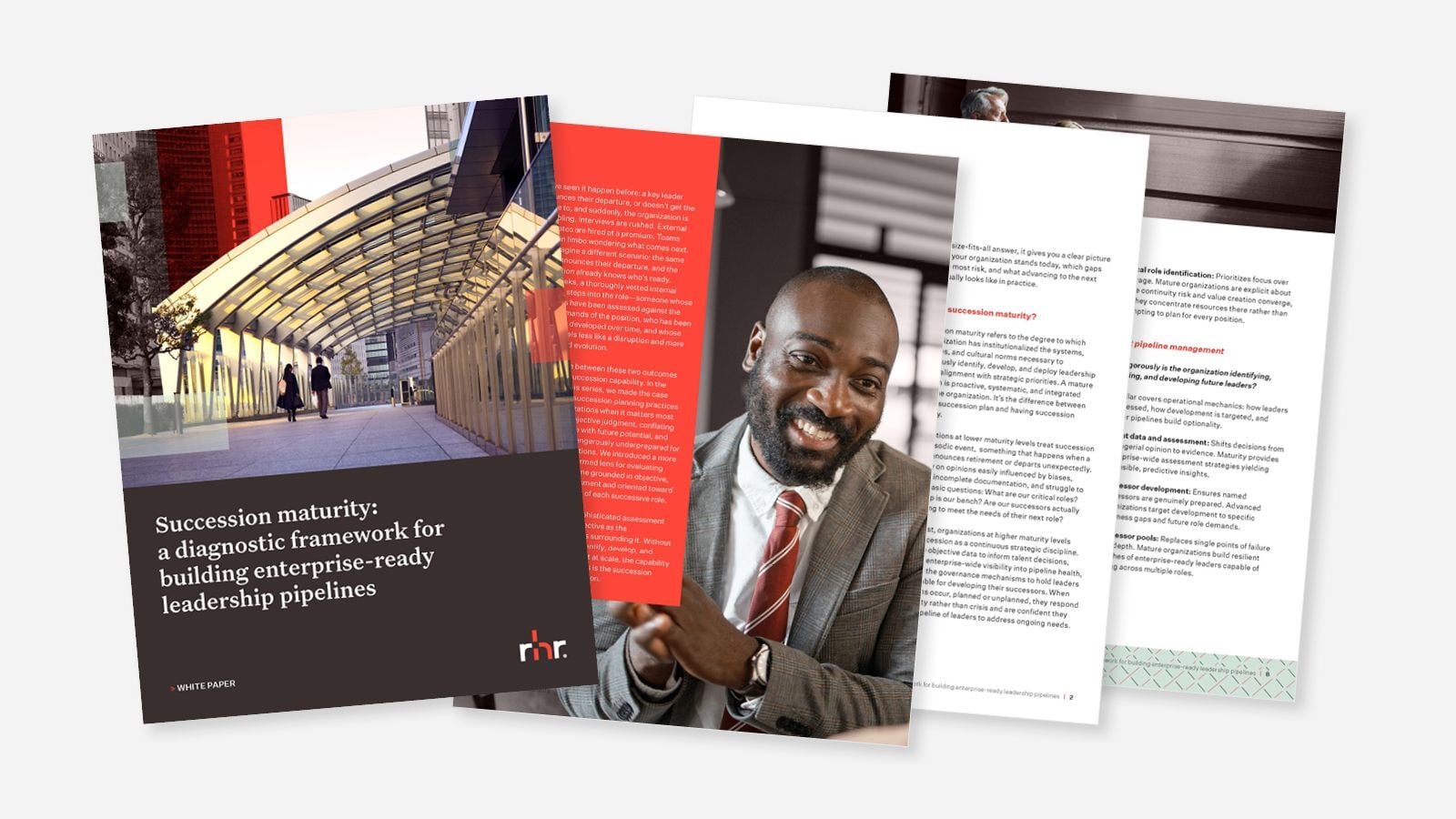
Succession and leadership pipelines
Organizations have a lot of talent, but not everyone’s skills are “fit for purpose.” Organizations are asking themselves:
- What skills and experiences do we need in our future leaders?
- Who is truly ready to step into critical roles?
- How do we accelerate readiness without burning people out?
In addition, succession planning is becoming more candid, data driven, and board visible.
Talent development with a future lens
After years of cost containment and reaction, many clients are reinvesting in leadership development—but with sharper expectations:
- Clear return on investment.
- Alignment with future strategy and technology.
- Development tied to real business challenges.
Stability, focus, and disciplined execution
Rather than chasing every new trend, leaders are seeking:
- Strategic focus.
- Fewer, clearer priorities.
- Leadership teams that can operate as true enterprise leaders.
Key insight:
The opportunity for 2026 is to intentionally build leadership capacity in the organization that directly aligns to future demands.
What this ultimately means for leaders and boards
Taken together, these insights point to a fundamental truth: the next era of leadership will reward those who invest early and honestly in their leadership systems.
The most effective organizations heading into 2026 will:
- View their leadership pipeline as both a strategic risk and an advantage.
- Develop leaders’ judgment, not just their skills.
- Prepare leaders to integrate technology, complexity, and human impact.
- Support leaders in sustaining performance over time.
In a world that is unlikely to get simpler, leadership quality will increasingly be the differentiator that matters most.
Let’s talk
To begin a conversation about your leadership goals for 2026, reach out to RHR at hello@rhrinternational.com.