





selection-onboard-internal-hero-mobile-9x16

Internal Promotion

Build leaders for what's ahead, not just the next role

Why internal promotion matters

Promotion decisions shape the strength and continuity of the leadership pipeline.

When organizations evaluate leaders through the lens of future enterprise demands—not only current performance—they build leaders ready to deliver on strategic priorities.

illust-mountaineers-transparent

Common challenges

At RHR, we often see organizations struggle to fully trust and leverage their internal leadership pipelines, particularly during periods of growth, transformation, or increased business pressure.

While organizations recognize the value of promoting from within, leadership decisions are frequently influenced by immediate operational demands, limited visibility into future potential, or uncertainty about whether internal leaders are truly ready to operate at the next level.

As a result, organizations may default to external hiring or make safer promotion decisions based on familiarity, tenure, or past performance rather than long-term leadership capability.

We also frequently see limited candid discussion around leadership readiness, making it difficult for organizations to accurately assess development gaps, succession risks, and future leadership potential.


Common challenges include:

  • Limited confidence in internal leadership pipelines
  • Short-term business needs overriding long-term leadership strategy
  • Safer promotion decisions favored over emerging capability
  • Lack of candid dialogue around leadership readiness
  • Focus on the next role instead of long-term leadership potential
  • Overreliance on past performance rather than future leadership capacity
  • Inconsistent criteria for evaluating internal talent across the organization
  • Difficulty identifying leaders who can scale with future business demands

Our approach

At RHR, we work with clients to strengthen internal promotion and succession decisions through a structured, data-driven approach grounded in leadership insight and business context.

We begin by clarifying the strategic expectations, leadership demands, and future requirements of the role to ensure organizations are assessing leaders against what success will truly require.

From there, we evaluate leadership capability, behavioral patterns, growth potential, and readiness for broader responsibility. This helps organizations compare leadership strengths objectively, identify development priorities, and make more confident talent decisions.

Why work with us

RHR integrates internal perspective with objective insight.

We challenge assumptions, clarify trade-offs, and help leaders make more confident promotion decisions while strengthening the long-term leadership pipeline.

Image of a business professional speaking during a meeting, representing leadership advancement, talent development, and RHR’s Internal Promotion Solutions.

Key resources and insights

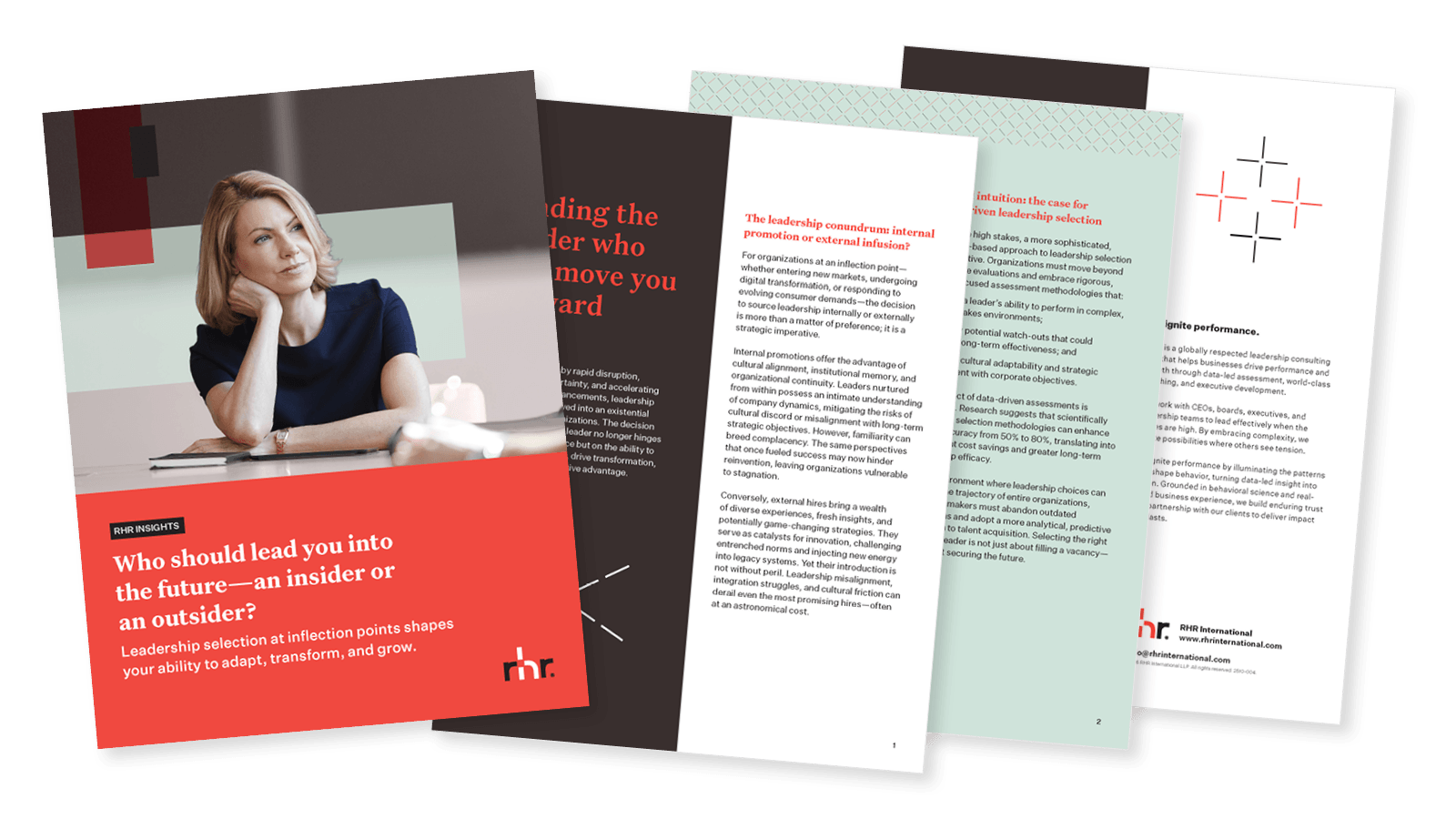
Cover and inside pages of a leadership selection guide titled “Who should lead you into the future—an insider or an outsider?” focused on executive hiring, leadership transitions, and organizational transformation.

Who should lead you into the future—an insider or an outsider?

Choosing between an insider or outsider is an existential challenge for any organization. With 50 to 70 percent of external hires failing within 18 months, the stakes are high.
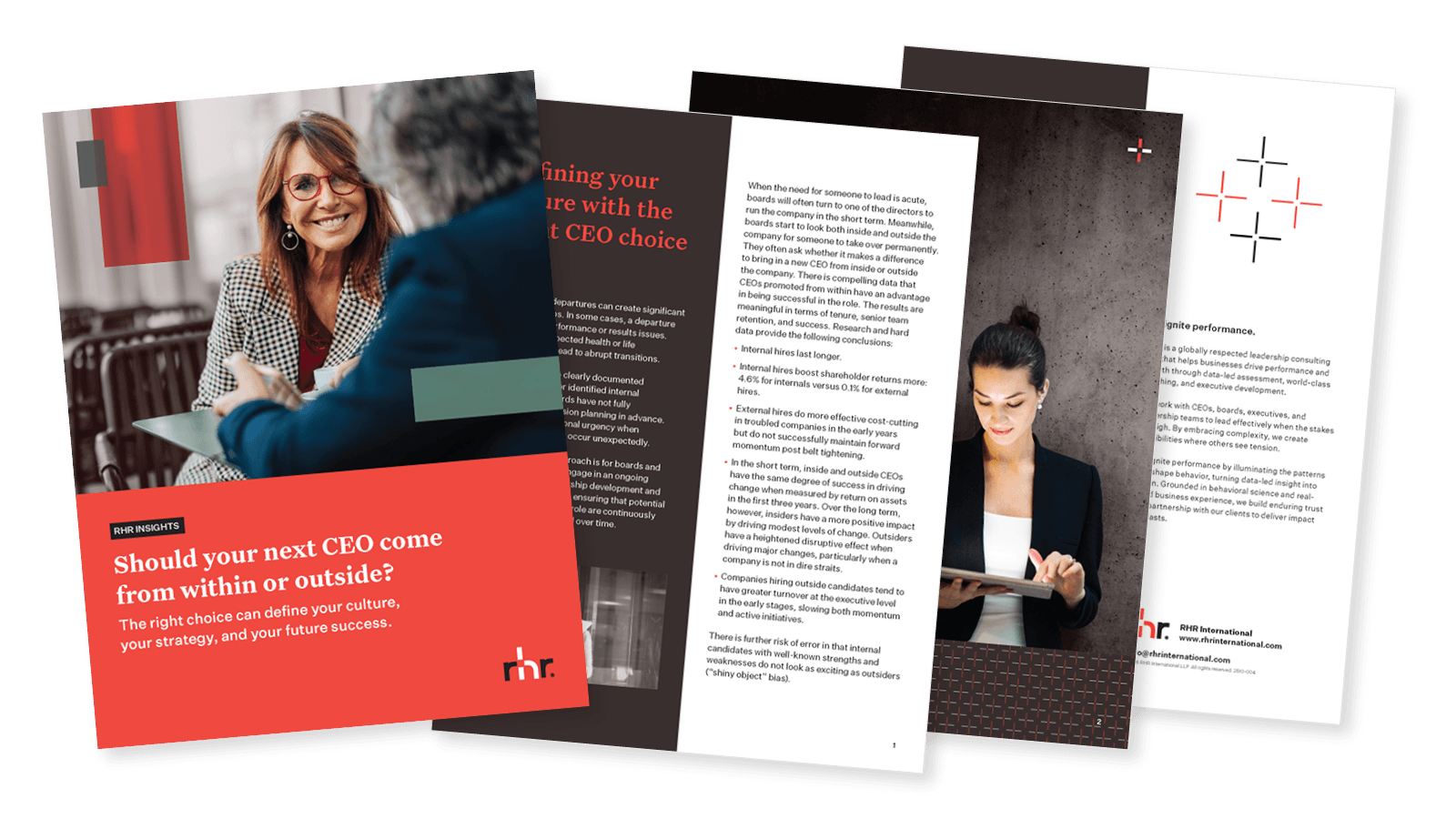
Cover and inside pages of a CEO succession guide titled “Should your next CEO come from within or outside?” focused on leadership selection, succession strategy, and long-term organizational success.

Should your next CEO come from within or outside?

Choosing your next CEO is a critical decision defining your future. While external hires offer fresh perspectives, research shows internal candidates often lead to longer tenures and higher shareholder returns.
Building a network and a legacy of internally promoted leaders has benefits that redound for years to come.
Valerie Nellen, PhD
Senior Partner, RHR
Case Study

When internal talent became the key to long-term growth

How we developed internal talent for executive roles

Succession starts with a strong foundation